You drive out of the bottom of a squat and your hips fire up first — your chest dives toward the floor, the bar stalls, and for a second you're basically doing a loaded good morning. If you've seen this on video, you've seen the "good-morning squat," and the fix is more specific than "keep your chest up."
Here's the part most articles get wrong: this is rarely a cue problem. You can't think your way out of it under a heavy bar. It's almost always a strength problem — and once you know that, the fix gets a lot clearer.
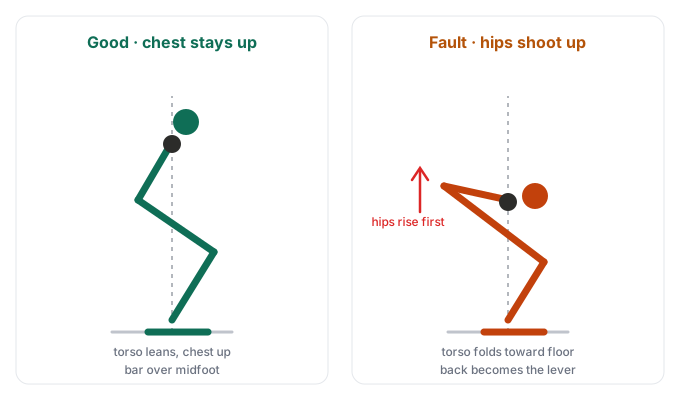
What the good-morning squat actually is
In a balanced squat, your hips and your chest rise at roughly the same rate, the torso angle stays about constant, and the bar tracks straight up over midfoot. In a good-morning squat, the hips rise faster than the shoulders. The torso pitches toward horizontal, the body folds in on itself, and the bar — which still has to stay over midfoot to keep you balanced — ends up sitting on a long, near-horizontal back. A leg exercise quietly becomes a back exercise.
It usually shows up at one specific moment: just out of the hole, at the hardest part of the lift (the "sticking point"), and it gets worse as the weight gets heavier.
Why your hips shoot up (it's usually not a cue problem)
When the load out of the hole is more than your quads can drive, your body does the rational thing: it offloads. Shooting the hips up gets knee extension "out of the way" early, with little change in your center of gravity, and dumps the remaining work onto the muscles that are already strong — your hips and lower back (Stronger by Science). So the most common root cause is simply:
Quads that are weak relative to your posterior chain. Your hips and back can move the weight; your quads can't hold their share, so the body routes around them.
Two other contributors stack on top of that:
- Load too heavy for the pattern. Even with adequate quads, grinding near-maximal weights forces the same offloading. The fault appears at heavy loads and disappears at light ones — that's a signal, not a coincidence.
- Bracing or cueing. Losing your brace at the bottom, or chasing depth so hard you collapse forward, can produce it too — but this is the minority case. If the fault is there at light loads with a solid brace, look here. If it only shows up heavy, it's strength.
Before you change anything, screen it the same way a coach would (the same screening-first logic we use for knee valgus):
- Film a working set from the side at 0.25x. Watch the moment out of the hole. Do the hips and chest rise together, or do the hips win the race?
- Test the load sensitivity. Does it happen at 70% of your working weight, or only near your top sets? Light-load fault points toward bracing/pattern; heavy-only fault points toward quad strength.
- Check the bar path. The bar should stay over midfoot. In a good-morning squat it stays over midfoot by folding your torso — the giveaway.
If you'd rather have a tool flag the timing for you, our squat form check watches the working reps and calls out when the hips rise early and the torso pitches forward.
Why it's worth fixing
- It stalls your squat. Your back becomes the limiting factor, so you fail squats with legs left in the tank.
- It loads the lower back hard. A near-horizontal torso under a heavy bar is a long lever on the spine — manageable on purpose (that's what a good morning is), but not what you signed up for on every squat rep.
- It hides leg-day stimulus. If the back keeps bailing you out, your quads never get the work that's supposed to be the point.
The fix: build the quads, then retrain the pattern
Eight to twelve weeks, two to three squat-focused sessions a week. The order matters — strength first, pattern second.
Step 1 — Drop the load (now, not later)
Take your working weight down to the heaviest load where your hips and chest rise together. Every heavy rep done in the good-morning pattern reinforces it. You're not losing progress; you're changing what you're training.
Step 2 — Build the quads
This is the actual fix. Bias movements that force the quads to do their job instead of letting the back take over:
- Front squats or heels-elevated / goblet squats — the more upright torso forces quad-dominant knee extension. Strong leverage point.
- Tempo and paused back squats — 3 seconds down, a 2-second pause at the bottom, controlled up, at 60–70% — removes the bounce so the quads have to start the rep.
- Split squats, Bulgarian split squats, walking lunges — unilateral quad strength with less spinal load, easy to add volume to.
Two to three of these per week alongside your reduced-load squats.
Step 3 — Retrain the pattern, then bring the load back
Once the quads are catching up, paused tempo squats double as the pattern drill: the pause kills momentum, so you have to drive with the legs and keep the chest with the hips. The cue that works isn't "chest up" (you can't out-cue a strength gap) — it's "chest and hips rise together," and "push the floor away" rather than "lift the bar." Re-film every two weeks; when the hips stop winning the race at 70%, add load back toward 100% over a few weeks.
For a clear walk-through of the fault and the fix, Squat University covers it well:
When it's not just weak quads
See a coach or physical therapist rather than grinding more drills if:
- There's pain in the lower back during or after squatting — stop loading and get it looked at.
- The fault is identical at light and heavy loads even with a deliberate, solid brace — points to a motor-control or mobility issue worth a hands-on assessment.
- Eight weeks of reduced load + quad work shows no change on side-by-side video.
- You have limited ankle dorsiflexion that forces a forward lean from the start — the ankle has to be addressed too (see the ankle screen in our knee valgus guide).
What to track
- Side-view video every two weeks at the same load (~70%), watched in slow motion. Do hips and chest rise together?
- Front-squat or heels-elevated squat strength — going up is your proxy for the quads catching up.
- The load at which the fault appears — it should creep upward over the weeks. When it disappears at your old working weight, you're done.
FAQ
Is the good-morning squat dangerous?
Not inherently — it's how you'd intentionally do a good morning. The issue is doing it unintentionally, rep after rep, under a load meant for your legs: it puts a long lever on your lower back and caps your squat. Fix it for performance and to keep heavy spinal loading deliberate rather than accidental.
Can't I just cue "chest up"?
Only if the cause is bracing, not strength. Under a heavy bar where your quads can't hold their share, "chest up" doesn't survive the sticking point — the body offloads to the back regardless of intent. Cues help; they don't replace the quad strength the pattern needs.
Do I really have to lower the weight?
Yes, temporarily. Loading the good-morning pattern heavily just rehearses it. Drop to the heaviest weight where hips and chest rise together, build the quads, and progress back up — most lifters recover the load within the 8–12 weeks.
Are front squats better than back squats for this?
For fixing it, front squats (and heels-elevated squats) are a strong tool because the upright torso forces quad-dominant work. They're a means, not a replacement — the goal is to bring that quad strength back to your regular back squat.
Sources
- Nuckols, G. — "Fixing the Good-Morning Squat." Stronger by Science.
- Horschig, A. — "The Top 3 Squat Problems & How to Fix Them." Squat University, and video demonstration.
We are experienced lifters who built an AI form-check tool, not licensed clinicians. The screening and programming here trace to the cited coaching and sports-science sources. If you have lower-back pain during squatting, stop and see a qualified professional before continuing.