You sink into the bottom of a squat and your heels peel off the floor — your weight rolls forward onto the balls of your feet, the bar drifts over your toes, and you feel like you're about to tip forward. If you've caught this on video, the quick diagnosis everyone gives is "tight ankles." That's the most common cause — but "just stretch your ankles" only fixes some lifters, and it helps to know which kind you are before you spend six weeks on calf stretches that were never the problem.
What "heels coming up" actually is
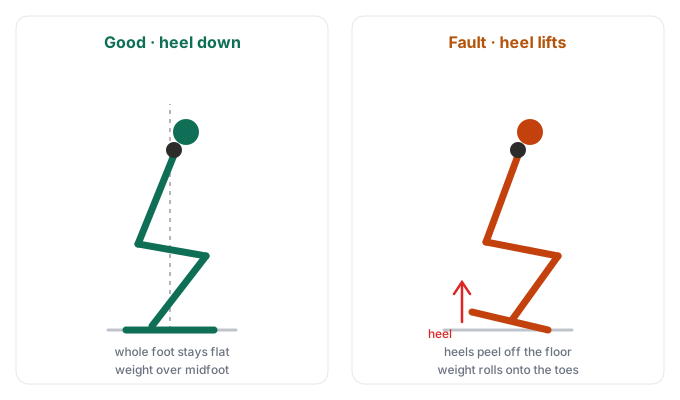
A squat is balanced when your whole foot stays flat and your weight sits over the midfoot — that's the base that keeps the bar tracking straight up. When the heels lift, you've lost that base: the weight shifts forward onto the balls of your feet, the knees shoot further over the toes, and the torso usually pitches forward to keep the bar over your center of mass. It almost always shows up at the bottom, in the deepest part of the rep, and gets worse the deeper you go.
Why it happens (the honest order)
1. Limited ankle dorsiflexion — the usual suspect. To stay flat at depth, your knee has to travel forward over your toes, and that requires the ankle to bend (dorsiflex). If the ankle runs out of range, the only way for the knee to keep moving forward is for the heel to come up. There are two flavors, and they need different fixes:
- A pinch at the front of the ankle = a joint/bony-type restriction. Stretching the calf won't touch this; banded joint mobilizations are the lever.
- A stretch or pull in the calf/back of the ankle = soft-tissue tightness, which responds to stretching and soft-tissue work.
2. The thing most articles skip: it isn't always the ankle. Sometimes the heel lifts because you're chasing a depth your hips can't yet control — the body borrows range from the ankle to get there. As Squat University points out, heels rising can be a hip strength-and-control issue masquerading as an ankle problem (Squat University). That's why endless ankle stretches do nothing for some people — they were stretching the wrong thing.
3. Setup and stance. A stance that's too narrow, toes pointed dead-ahead, or forcing an artificially upright torso (trying to high-bar squat bolt-upright when your proportions want a slight lean) all push you to the front of your foot. Cheap to test, cheap to fix.
Screen it first (don't guess)
The same screening-first logic we use for knee valgus: find the cause before you pick a drill.
- Knee-to-wall test. Kneel facing a wall, front foot a few inches back, and drive the knee forward to touch the wall without the heel lifting. Slide the foot back until that's the farthest you can reach. Measure toe-to-wall, and compare left vs right — a big side-to-side gap points to a one-ankle restriction, not a strength issue.
- Film a working set from the side at 0.25x. When does the heel lift — only at the very bottom, or early in the descent? Both heels, or just one?
- The heel-elevated test (the tie-breaker). Redo the squat with your heels on small plates or in lifting shoes. If your heels now stay down and depth looks clean, it's an ankle-range problem. If your heels still peel up even elevated, the range isn't the limiter — look at hip control (point 2).
If you'd rather have a tool flag the moment for you, our squat form check watches the working reps from the side and calls out when your weight shifts forward and the heels leave the floor.
The fix
Train today: elevate the heels (it's not cheating)
Put your heels on a pair of small plates, or wear weightlifting shoes. This isn't a cop-out — it matches the lift to the ankle range you have right now so you can keep squatting with a flat, stable base while you build more range underneath it. Plenty of strong lifters squat heel-elevated permanently; it biases the quads and there's nothing wrong with it.
Build the range (if the screen said ankle)
- Knee-to-wall mobilizations — drive the knee over the toe, heel down, for reps, then squat immediately to "use" the range you just opened up.
- Banded ankle distraction — loop a band around the front of the ankle, pull it back, and rock the knee forward. This is the one that helps a front-of-ankle pinch (the joint-type restriction) where stretching does nothing (Squat University).
- Calf work — if your restriction is a back-of-ankle stretch, then yes, foam-roll and stretch the calves.
Cheap wins that buy range instantly
- Widen your stance a little and turn the toes out ~15–30° — this opens room for the knees to track out rather than straight forward, and often drops the heels back down without any mobility work.
- Stop forcing an upright torso. A small forward lean is normal and lets you stay over midfoot.
If the screen said hip control
Tempo and paused squats (3 seconds down, 2-second pause at the bottom, at 60–70%) teach you to own the bottom position instead of dive-bombing into it. Heels-elevated goblet squats let you groove a flat-foot pattern with a load you control.
When to see a professional
- A painful pinch in the front of the ankle, not just tightness.
- Almost no dorsiflexion at all, or a previous ankle sprain/fracture on that side.
- A big left-right asymmetry that doesn't budge after a few weeks — worth a hands-on assessment.
What to track
- Knee-to-wall distance (in cm) for each ankle — your dorsiflexion should improve over weeks.
- Side-view video at the same depth and load — do the heels stay planted?
- The depth at which the heels lift — it should get deeper over time.
FAQ
Why do my heels come up when I squat?
Most often because your ankles can't bend (dorsiflex) far enough for the knees to travel forward while staying flat, so the heels lift to let the knees keep moving. Less often, it's a hip strength/control issue — the body borrows ankle range to reach a depth it can't yet control — or simply a stance that's too narrow or a torso forced too upright.
How do I stop my heels coming up?
Screen it first. If it's ankle range, elevate your heels to keep training and add knee-to-wall and banded-distraction mobility work; widening your stance and turning the toes out also buys range immediately. If your heels lift even when elevated, it's hip control — work paused/tempo squats instead of more ankle stretching.
Is it bad if my heels come up when squatting?
It's not an injury, but it costs you: you lose your stable base, the bar drifts forward, the torso pitches over, and the lift gets less efficient and harder to balance under heavy weight. Worth fixing for stability and strength, not because it's "dangerous."
Are heel-elevated shoes or plates cheating?
No. Elevating the heels matches the squat to your current ankle range so you can train with a flat, stable foot. It biases the quads and many strong lifters use it permanently. Use it as a tool while you build mobility, or keep it if you like how it squats.
Why does only one heel come up?
That points to a side-specific ankle restriction (often an old sprain) rather than a general mobility or strength issue. Check your knee-to-wall measurement on each side — if one is clearly shorter, focus mobility work there, and consider a hands-on assessment if it won't change.
Sources
- Horschig, A. — "The Squat Fix: Ankle Mobility (Pts 1–3)." Squat University.
- "Heels Come Up When You Squat? Here's How To Fix It." GMB Fitness.
- "How To Increase Ankle Mobility For Squats." PowerliftingTechnique.
We are experienced lifters who built an AI form-check tool, not licensed clinicians. The screening and drills here trace to the cited coaching and sports-science sources. If you have ankle pain — not just tightness — stop and see a qualified professional before continuing.